GLOBE Eclipse is a temporary tool in the GLOBE Observer app (details about downloading the app) that will help you document air temperature and clouds during an eclipse. The tool is not visible in the app on a regular basis, but is only opened up when a solar eclipse is happening somewhere in the world. The Eclipse tool will prompt you to take air temperature measurements using a meteorological thermometer, as well as taking regular observations of sky conditions using the Clouds tool, and an observation with the Land Cover tool to characterize the vegetation near the data collection site. For more details about equipment needed, how to take observations, and frequently asked questions, visit the Taking Observations page. Our Resource Library includes additional activities, references and videos. In addition, additional resources (including presentation slides) for facilitators leading a program related to the eclipse can be found in the eclipse section of the Toolkit for Informal Educators.
Energy from the Sun warms our planet, and changes in sunlight can also cause changes in temperature, clouds, and wind. What happens when the Sun is blocked by the Moon during an eclipse? How will the eclipse affect these solar-powered processes?
During an eclipse, citizen scientists are able to:
Observe how the eclipse changes atmospheric conditions near you by reporting on clouds and air temperature
Report surface conditions (photograph and describe the landscape) that may have an impact on differences in the atmospheric effects in varying locations
Contribute to a citizen science database used by scientists and students to study the effects of eclipses on the atmosphere
Provide comparison data even if they are not in the path of totality
NOTE: The Eclipse tool is not currently visible in the GLOBE Observer app. It will next be released for the annular eclipse on 14 October 2023 and the total solar eclipse on 08 April 2024.
Viewing Eclipses Safely
The Sun is never completely blocked by the Moon during an annular solar eclipse. Therefore, during an annular eclipse, it is never safe to look directly at the Sun without specialized eye protection designed for solar viewing. During a total solar eclipse, the only safe time to view the Sun without protection is the few minutes of totality, when the Sun is completely blocked by the Moon. Viewing any part of the bright Sun through a camera lens, binoculars, or a telescope without a special-purpose solar filter secured over the front of the optics will instantly cause severe eye injury.
When watching an annular solar eclipse directly with your eyes, you must look through safe solar viewing glasses (“eclipse glasses”) or a safe handheld solar viewer at all times. Solar viewing glasses are NOT regular sunglasses; regular sunglasses, no matter how dark, are not safe for viewing the Sun. Safe solar viewers are thousands of times darker and must comply with the ISO 12312-2 international standard. Always inspect your eclipse glasses or handheld viewer before use; if torn, scratched, or otherwise damaged, discard the device. Always supervise children using solar viewers.
For more about eclipse safety, including indirect ways to view the eclipse without eclipse glasses, please visit the main NASA Eclipse Safety website.
Past Eclipses
During the total solar eclipse on 21 August 2017, with a path of totality spanning the United States, more than 10,000 observers helped us collect over 20,000 cloud observations with 60,000 photos and 80,000 air temperature measurements to answer these questions and others using the GLOBE Observer app. (See the 2017 version of this page.)
Clouds observations (left) and air temperature measurements (right) from 21 August 2017, GLOBE Visualization System.
For the total solar eclipse on 02 July 2019, the path of totality went across Chile and Argentina. An area with less overall population than the 2017 eclipse, we received 73 clouds observations and 1727 air temperature measurements on the day of the eclipse.
Clouds observations (left) and air temperature measurements (right) from 02 July 2019, GLOBE Visualization System.
For the total solar eclipse on 14 December 2020, the path of totality also went across Chile and Argentina, a bit further south than the 2019 eclipse. We received 856 air temperature measurements from the area experiencing the eclipse, as well as 232 clouds observations. These represent contributions from nearly 100 unique observers. Read more in the summary news article about the event.
Clouds observations (left) and air temperature measurements (right) from 14 December 2020, GLOBE Visualization System.
The video below was created for the eclipse in August 2017, but explains why NASA needs your help making observations during any eclipse.
Student Research
In addition to research done by professional scientists, because GLOBE Observer is part of the GLOBE Program, which is active in thousands of schools across the world, citizen scientists are strengthening science education by providing data for student research.
Here are a few examples of student research reports related to eclipses:
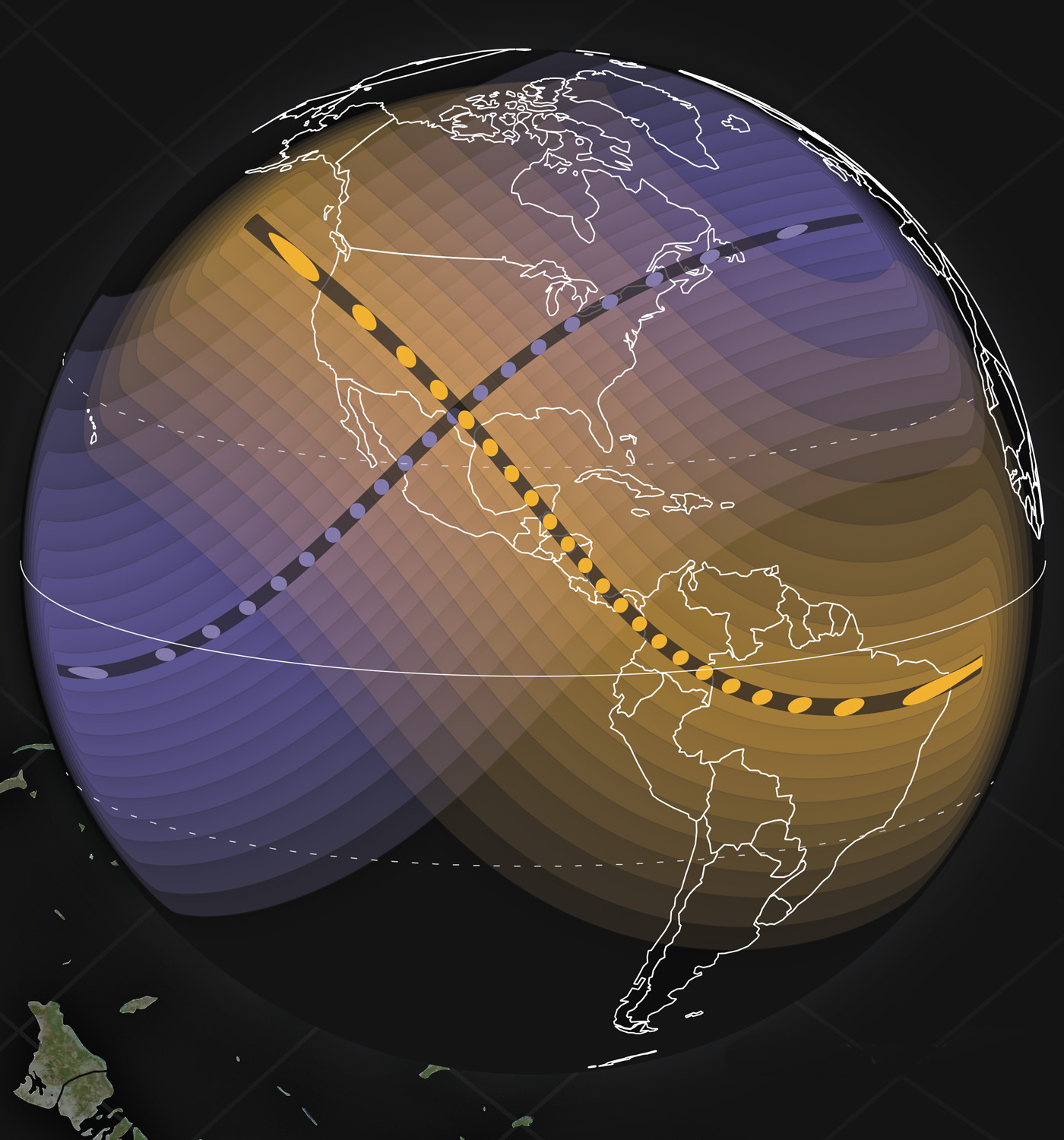
On 14 October 2023, an annular eclipse will take place in North, Central and South America. The path of maximum eclipse will be across parts of the United States, Mexico, Belize, Honduras, Nicaragua, Costa Rica, Panama, Columbia and Brazil (the path from upper left to lower with yellow circles in the diagram below). A partial annular eclipse will be visible in Canada, and other parts of Central and South America. This map of the 2023 eclipse shows the percentage of obscuration for any location.
The next full total solar eclipse will take place on 08 April 2024 and the path of totality will pass across North America, including Canada, the United States and Mexico (the lower left to upper right path with blue circles in the diagram above). Outside this path, a partial solar eclipse will be visible in Greenland and Central America. To find out exactly how much of the eclipse a particular location will experience, visit this map of the 2024 eclipse.